
Dragon Trail International, June 2026
China’s outbound travel market runs on its own digital ecosystem, one that looks almost nothing like the apps and platforms most Western tourism marketers are used to. This article breaks down how Chinese travelers actually use social media and digital tools to plan, book, and share their trips abroad, and what that means in practice for destinations, hotels, airlines, and other travel brands trying to reach them.
We’ll cover four things:
- The Chinese digital landscape: the key platforms and trends shaping travel marketing in China today
- The Chinese traveler’s digital journey: survey data showing how travelers move from inspiration to booking to sharing
- The must-know platforms: a practical guide to each one and how to use it
- AI in Chinese travel: how artificial intelligence is starting to reshape the market
1. The Chinese Digital Landscape
The basics, if you’re new to this
The single most important thing to understand: the Chinese digital landscape is very different from the rest of the world. Facebook, Google, Instagram, and YouTube are all blocked in China. Expedia barely has market share. In their place is a completely separate set of Chinese apps, social platforms and booking sites.
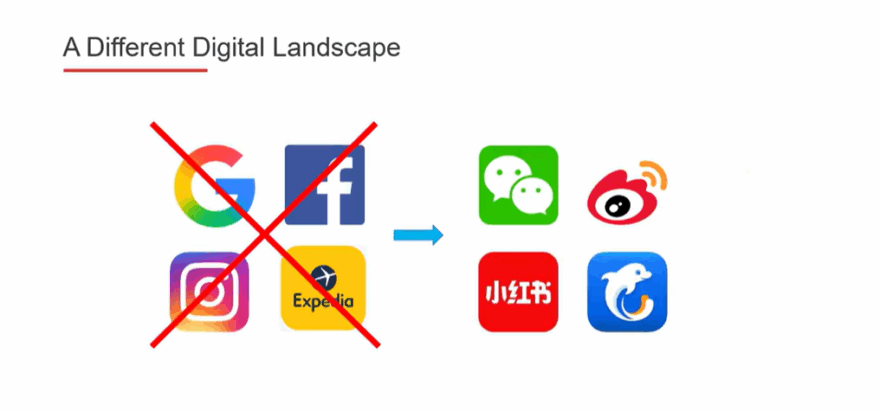
If you only learn three names, make them these:
- WeChat – a do-everything app combining messaging, social feeds, payments, and business accounts
- RedNote (known in China as Xiaohongshu, or “Little Red Book”) – a search platform that’s become the go-to place for travel planning
- Weibo – an older, Twitter-like platform still useful for viral content and celebrity-driven campaigns
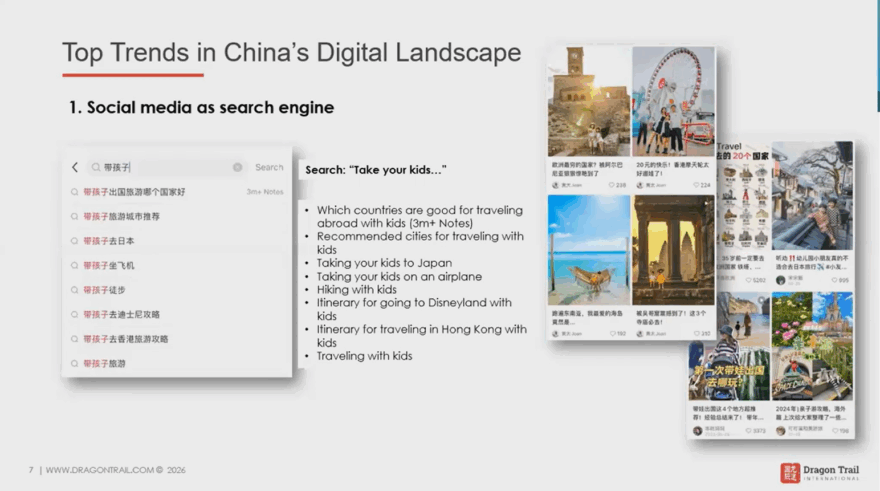
Must-know trend: Social media is now the search engine
Chinese consumers don’t really use Baidu (China’s Google-equivalent search enging, it exists but isn’t great) to look up travel information. Instead, RedNote and WeChat function as primary search engines, with around 600 million searches on each.
What this means for marketers: your content needs to lead with useful, practical information, not just beautiful aspirational photography. Travelers are actively searching for answers “where to take kids abroad”, “what to pack for X”, not just scrolling for inspiration.
Good to know: How the algorithms work (and why it matters for who you work with)
RedNote and Douyin (the original Chinese version of Tik Tok) use interest-based algorithms rather than follower-based ones. In practice, this means:
- Every new post is shown to a small test audience
- If it performs well there, the platforms pushes it to progressively larger audiences
- The quality of the content matters more that the size of the account posting it – a small account can go viral with the right post
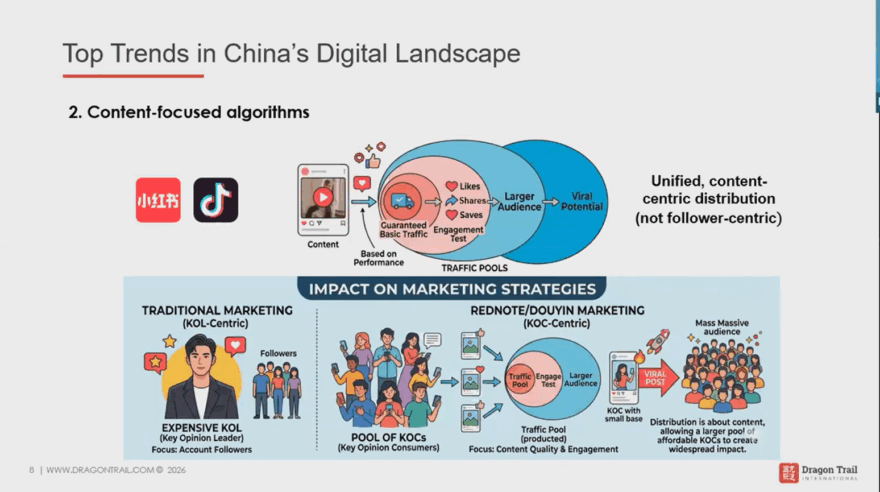
While this information might not be a top-line takeaway, it explains an important shift in marketing strategy: many brands now spread their budget across a larger pool of smaller creators called KOCs (Key Opinion Consumers) instead of a just a few expensive celebrity endorsements from KOLs (Key Opinion Leaders).
Influencer marketing trend
Influencer content has a bigger impact on where Chinese travelers decide to go rather than content from official tourism boards or embassies. Influencers also already have followers spread across relevant platforms, which a single brand account typically doesn’t.
Because the Chinese outbound market is so demographically diverse, there’s no single «right» influencer strategy. Brands need to match influencer choice to their target segment (e.g., silver travelers, family travelers, luxury travelers).
Two influencer trends worth flagging:
- Niche travel influencers: a shift away from generic group tours toward highly personalized trips built around specific interests (astronomy, piano music, etc.). These audiences are smaller but far more engaged
- KOS (Key Opinion Sales): a newer category of influencer who sells travel products directly to followers, particularly useful for hotels and cruise lines
The authenticity trend
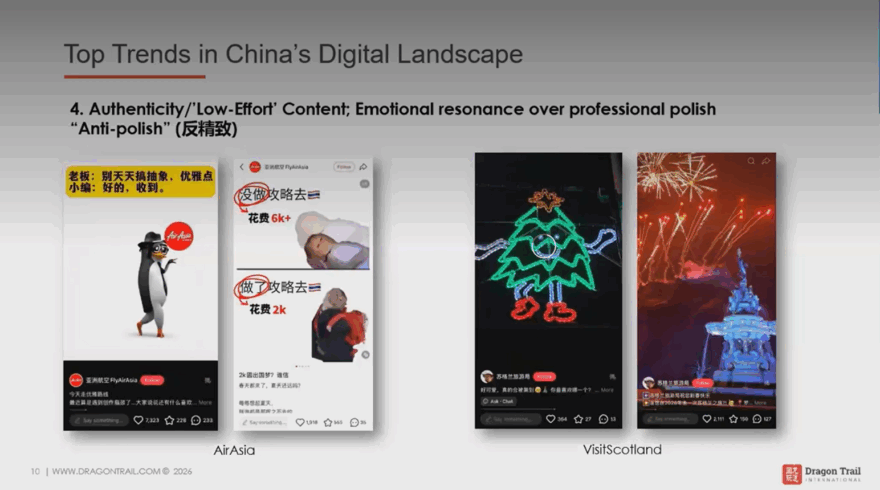
Chinese social media users are increasingly tired of overly polished, «unattainable» content and are favoring real, unpolished posts. A few data points and examples:
- User-generated content (UGC) makes up 90% of all content on RedNote
- AirAsia got strong engagement in 2024 from short videos of cabin crew’s daily lives, filmed on crew members’ own phones
- Individual store or branch accounts (rather than one central brand account) often out-perform on engagement because they feel more local and authentic
- This is also why KOCs (smaller creators) often deliver better results than KOLs: smaller audiences, but more trust and engagement
2. The Chinese Traveler’s Digital Journey
Three things to understand before diving into the data:
- Chinese travelers stay inside the Chinese app ecosystem for their entire journey. Even experienced international travelers who also use Instagram or TripAdvisor will be using Chinese apps in addition to, not instead of, those tools.
- WeChat alone covers more than half of the touchpoints in a typical journey, because it bundles search, payments, mini-programs (small in-app tools), social sharing, and private chat into one app.
- Other apps are increasingly competing with WeChat and OTAs (Online Travel Agencies, like Ctrip) by adding booking functionality directly into their platforms, to keep users, and their spending, in-app for longer.
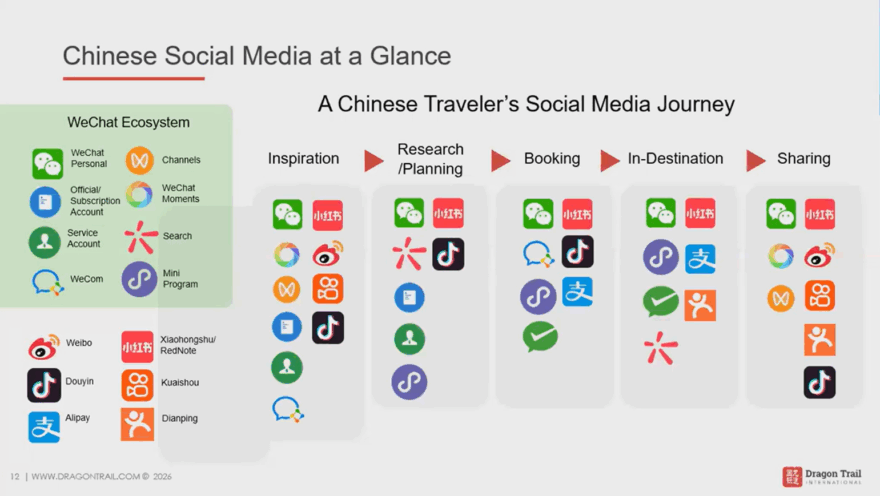
The data below comes from Dragon Trail’s own consumer and travel trade surveys from April 2025.
Inspiration around outbound travel
- 50% of Chinese travelers cite social media apps as their top source of destination inspiration
- 39% are inspired by friends, family, and acquaintances
- 30% are inspired by Chinese OTAs like Ctrip (China’s largest OTA)
Deeper dive: what destinations and content resonate:
When asked which destinations they’d been most inspired to visit via social media, respondents mentioned a wide range, with the Maldives the most frequent, driven by natural scenery like quiet islands and clear water. More distant destinations like Iceland, New Zealand, and Switzerland also scored well for unique landscapes.
Leisure and shopping experiences drove interest in destinations like South Korea and Thailand, while cultural appeal drove interest in Japan, Russia, Italy, and Egypt. Beyond the destination itself, content emphasizing practical travel factors, visa-free policies, safety, ease of communication, proximity to China, good infrastructure, and cost, meaningfully increases intent to visit. This reinforces the broader point from Section 1: practical, reassuring information converts better than pure aspiration.
Research and planning
- RedNote: 53% (top source)
- Douyin: 48%
- Online travel platforms (e.g. Ctrip): 42%
There’s a clear age divide in where travelers go for information. Younger travelers lean heavily on RedNote and Douyin. Older travelers rely more on WeChat, traditional travel agencies, tour guides, and recommendations from friends and family. This matters for targeting: a campaign built entirely around RedNote will likely underperform with older demographics.
Booking
- OTAs like Ctrip and Qunar: 63% (top channel)
- Official brand channels (airlines, hotels, attractions directly): 50%
- International platforms like Airbnb: 39% (rising to 47% among 18-24 year-olds)
- Social media platforms (WeChat, RedNote, Douyin): 38%
- Traditional travel agencies: strongest with the 45-65 age group (49% online, 25% offline)
Deeper dive: the short planning window, and social commerce to watch
Chinese outbound travelers plan relatively last-minute by global standards: 37% start planning just one month before their trip, and only 9% start more than three months out. This has real implications for campaign timing: content needs to be discoverable close to the trip, not just months in advance.
Worth watching: while OTAs still dominate booking today, social platforms, especially RedNote, are actively building out in-app booking features, and travel agents are increasingly selling through social channels with good results. This is a space likely to shift over the next few years.
In the destination
Once Chinese travelers arrive at their destination, they’re likely to keep using RedNote on the go, to find guides and recommendations, alongside review apps and WeChat mini-programs.
They’re also increasingly likely to be using Chinese mobile payment platforms, as these are now accepted in more countries and by more businesses overseas. In China, most people haven’t paid with cash for years, payments are usually made through smartphones, mostly via Alipay or WeChat Pay. Chinese travelers tend to prefer keeping to these same payment platforms while overseas, for convenience and security.
- More than half of outbound travelers had used Alipay on a past outbound trip — ranking nearly as high as cash and China UnionPay card payments
- 35% had used WeChat Pay overseas in the past
- 94% of surveyed Chinese outbound travelers share their travel experiences online, with 80% of those sharing while still traveling
- Most share more than one post during the trip; 34% share every day while traveling
- The top three platforms for sharing are WeChat Moments, RedNote, and Douyin
This is also where the cycle starts again: what travelers share becomes inspiration and useful reference material for others in their network, feeding back into the inspiration stage covered earlier.
Niche segments worth knowing about
Silver travelers (age 60+). A relatively small slice of the outbound market, but a valuable one: they have more flexible schedules and more disposable income, making them especially relevant for long-haul destinations. They’re also more digitally active than you might expect: as of June 2025, China had 161 million «silver netizens» aged 60+, meaning roughly one in two seniors is digitally active. For this group, WeChat and offline channels (travel agency stores, word of mouth) matter more than RedNote or Douyin.
Luxury travelers. Word-of-mouth remains the single most influential factor, but social media influencers are a close second, cited by a third of luxury travel agents and by more than half of luxury hospitality partners as the most effective way to reach high-net-worth Chinese travelers. RedNote and WeChat are the two key platforms here, and the advice from industry experts is consistent: lead with storytelling and emotional resonance, not overt promotion.
3. Must-Know Platforms
Here’s a practical, platform-by-platform guide to where Chinese travel marketing actually happens.
WeChat: the «Swiss Army knife» app
WeChat is used by roughly 78% of people aged 16-64 in China and accounts for 35% of all mobile usage time in the country, making it China’s single most-used app. Its strength is that it bundles everything into one place: chat, search, a social feed («Moments»), payments (WeChat Pay), business/service accounts, mini-programs (lightweight apps that live inside WeChat), and WeChat Channels for video.
A recent, important change for brands: overseas tourism businesses can no longer open a «subscription» or «official» account unless they hold a Chinese business license. Only a «service» account is available otherwise (some brands work around this by having their Chinese marketing agency open the account, though this can create ownership disputes down the line, so it’s worth having the account registered under your own business license wherever possible). As of this spring, service accounts can now also post as frequently as the old subscription accounts could, which is a meaningful shift.
How to use it: think of your WeChat account less as a place for viral discovery, and more as a trustworthy resource library, somewhere travelers who are already searching for information about you can find in-depth, evergreen content (destination guides, FAQs, booking info). Use the menu bar to organize content by theme or by city. For actual discovery and virality, pair your service account with a separate WeChat Channels account for video content, which is far more likely to reach new audiences.
Weibo: the platform for virality and celebrity campaigns
Weibo is one of China’s oldest social platforms, and while it hasn’t added many new features recently, it’s still valuable for open, public conversation, giveaways, hashtags, and celebrity-driven campaigns. Recommended posting cadence is 3-4 times a week, ideally around commute times and after meals.
Weibo campaigns are frequently built around celebrity ambassadors and pop culture tie-ins, for example tourism boards partnering with well-known actors or athletes, or tying content to a popular Chinese TV show or a musician’s tour stop. This is the platform where «who’s the face of the campaign» tends to matter more than on other channels.
RedNote (Xiaohongshu / «Little Red Book»): the biggest platform to watch
RedNote has been the single biggest development in Chinese travel marketing over the past five years. It grew from 30 million users in 2018 to over 300 million by the end of 2023, and its role in travel planning has only grown since. Its core strength is a strong search function (600 million searches/day) combined with content that’s majority user-generated, which is why it feels more authentic and trustworthy than more curated platforms. Its core demographic, young, affluent women in tier-1 Chinese cities, happens to overlap heavily with the core outbound travel demographic.
RedNote has two built-in tools for working with creators:
- Pugongying («dandelion») — for finding and commissioning creators with 1,000+ followers (fam trips, paid content)
- Creator Hub — a lighter-weight tool for finding smaller creators (under 1,000 followers) who’ve already posted about your brand organically, so you can contact them directly or pay to boost their existing post
Good to know: brands are also tapping into gaming and pop-culture tie-ins here (e.g., partnerships with popular Chinese mobile games or TV adaptations) to drive engagement. A more experimental tactic than the core search/UGC strategy, but one that’s worked well for a few destination campaigns.
Douyin: influencer content, not brand accounts
Douyin is the domestic Chinese version of TikTok (it’s a separate app from international TikTok, with no content crossover; you’d need a VPN and a Chinese app store account to even access it from outside China). It has over 400 million users interested in travel content, and has seen a strong post-pandemic rise in travel-related searches, content, and in-app purchases.
Practical note: it’s still uncommon for overseas tourism brands to run their own Douyin account, so this isn’t usually a channel where you invest in owned content. Instead, work with influencers who are active there, and focus your own video content creation on WeChat Channels and RedNote.
Online Travel Agencies (OTAs)
This is where most Chinese outbound bookings actually happen, and OTAs are also a meaningful source of inspiration in their own right.
- Ctrip (Trip.com Group) — China’s largest OTA
- Qunar — also owned by Trip.com Group, slightly more domestically focused, but with overseas products too
- Tuniu — focused mainly on group travel, especially long-haul
- Tongcheng — owned by WeChat’s parent company Tencent, integrated directly into WeChat for bookings
- Fliggy — owned by Alibaba; functions more like an e-commerce marketplace where brands run their own «shops»
- Meituan — strongest for overseas hotel bookings, dining, and attraction tickets
Trip.com Group (Ctrip + Qunar combined) accounts for nearly half of the online outbound travel market, and over 60% of group travel bookings. Fliggy has grown to roughly a third of the market and leads specifically with younger, independent travelers.
Travel review platforms
These matter most for FITs (fully independent travelers), dominated by millennials born in the 1980s and 90s, who make up around half of all Chinese outbound travelers. The two biggest are Qyer and Mafengwo, both used for destination research, travel diaries, and reviews, and both function partly as booking platforms too. Dianping (used by around a third of outbound travelers) is the go-to for restaurant and local business reviews, and is especially popular with millennials in tier-1 cities. Brands can improve their standing here with good photos, accurate listings, influencer partnerships, and promotions.
4. AI and Chinese Travel Marketing
AI adoption in China’s travel industry has moved fast, and traveler sentiment has shifted dramatically in just a year.
- 70% of Chinese travelers now use AI to help plan their trips (per the China Tourism Academy)
- Attitudes flipped in a single year: the share who called AI travel assistance «not useful enough» dropped from 51% (2024) to just 14% (2025), while those optimistic about its future rose from 5% to 37%
- The most-used AI tools for trip planning are DeepSeek (64%) and Doubao (63%), followed by Trip.com’s AI assistant (51%) and RedNote’s AI function (45%)
- Travelers see the biggest AI benefit in language translation first, then itinerary planning, then bookings
- 82% of Chinese travel trade companies already use AI in their operations
Deeper dive: the shift toward «agentic» AI
Until last year, most AI tools from Chinese OTAs were fairly simple: itinerary planners, local guides, menu translators. In early 2026, that changed. Alibaba and ByteDance both launched «agentic» upgrades to their chatbots that can actually complete tasks on a user’s behalf, like ordering food or buying a plane ticket, rather than just providing information. Chinese AI companies distributed roughly $1.2 billion in coupons to encourage adoption of these new features.
The impact was immediate for travel specifically: Alibaba’s travel platform Fliggy saw its AI-driven bookings increase 800% around Chinese New Year, with attraction ticket bookings the most popular use case. This is a fast-moving space worth watching closely over the next year, since it signals AI moving from an information tool to a transaction tool.
How brands and agencies are actually using AI
Beyond consumer-facing tools, there’s a growing B2B use case for AI in travel marketing: itinerary generation, translation and interpretation for trade events, faster video editing from raw footage, training material generation, and reporting dashboards that track brand reputation and campaign performance across platforms.
One area gaining attention: GEO (Generative Engine Optimization), essentially SEO adapted for AI chatbots and assistants rather than traditional search engines. As more Chinese travelers ask AI tools directly for recommendations, making sure your brand’s information is structured in a way AI systems can find and use accurately is becoming a real consideration, not just a novelty.
About Dragon Trail International
Dragon Trail is a marketing solutions company headquartered in Beijing. Since its founding in 2009, Dragon Trail has focused on marketing for Chinese outbound tourism, working with destinations, hotels, airlines, retailers, attractions, and other travel brands and businesses around the world to help them reach Chinese consumers and the Chinese travel trade.